
August 12, 2026
Automatic Part Removal Robots for Injection Molding: From Mold Opening to Part Handling
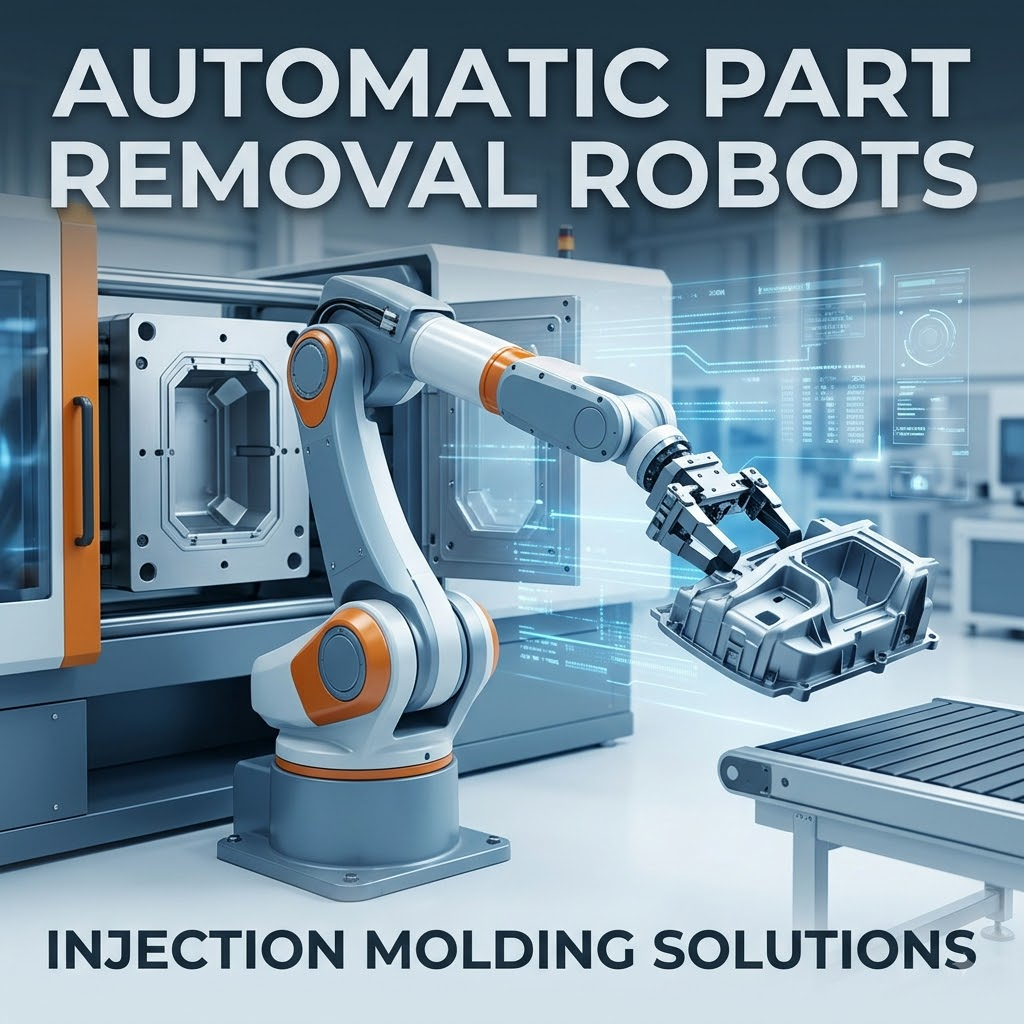
I've spent enough time on injection molding shop floors to know that most people don't think much about what happens after the mold opens. The part is there. Someone grabs it. The cycle continues. Simple, right?
But here's the thing. That "someone grabbing it" moment is often the biggest bottleneck in the entire production process. And it's also where a lot of things can go wrong—parts get dropped, they get handled inconsistently, they cool unevenly, they pick up contamination from human contact.
The global market for robots used in injection molding machines was valued at roughly USD 639 million in 2025 and is projected to reach USD 855 million by 2032, growing at a compound annual rate of about 4.2%. That's not a huge market compared to some industrial automation segments, but the growth is steady and the applications are expanding.
I've seen plants where an automatic part removal robot paid for itself in under a year just from the labor savings alone. And I've seen others where the robot sat idle because nobody thought through the integration properly.
This guide is for anyone involved in specifying, procuring, or implementing part removal automation in injection molding. Whether you're a plant manager trying to justify the investment, an engineer designing a new cell, or a procurement professional evaluating suppliers, I'll walk through what actually matters—from mold opening to part handling and everything in between.
Table of Contents
1. What Is an Automatic Part Removal Robot?
2. Why Part Removal Automation Matters
3. Key Robot Types for Injection Molding
4. The Anatomy of a Take-Out Robot
5. End-of-Arm Tooling: The Part That Actually Touches Your Parts
6. Robot–IMM Integration and Communication
7. Selecting the Right Robot for Your Application
8. Application Examples and Case Studies
9. Calculating ROI for Part Removal Automation
10. Frequently Asked Questions
11. Conclusion
What Is an Automatic Part Removal Robot?
Let's start with the basics.
An automatic part removal robot—often called a take-out robot—is a specialized piece of automation equipment designed to remove molded parts or runners from the injection mold cavity immediately after the injection process completes. That's the straightforward definition.
But what it really does is more interesting. It takes over the repetitive, timing-critical task of extracting parts from the mold, placing them somewhere predictable, and doing it consistently—cycle after cycle, shift after shift, without fatigue, without distraction, without variation.
These robots are highly specialized automation equipment designed to efficiently and precisely remove molded parts from the mold cavity. They play a critical role in improving cycle time, yield rate, and overall production consistency.
The simplest take-out robots are basically automated arms with grippers. The more advanced ones incorporate vision systems, AI algorithms, and adaptive gripping technologies to handle complex geometries and multiple product lines.
Why Part Removal Automation Matters
Let me give you some context.
Years ago, it was common to either run molds in full automatic mode with parts dropping into a bin—or to employ an operator to manually open the gate and remove the parts. Both approaches have problems.
Parts dropping into bins can get damaged. They can get mixed up. They can cool unevenly. And manual removal? It's slow, it's inconsistent, and it ties up a person who could be doing something more valuable.
The benefits of using a part removal robot include:
Achieving a consistent cycle time
Improved part handling with less damage
Maintaining cavity separation for multi-cavity molds
Maintaining part orientation for downstream operations
Providing mold protection (the robot won't close the mold on itself)
Reducing labor costs
Reducing cycle time in many situations
And here's something that's been true for at least 20 years: the capabilities of part removal robots have consistently expanded while their prices have consistently decreased. That trend hasn't stopped.
Key Robot Types for Injection Molding
Not all take-out robots are the same. The type you choose depends on your part, your mold, your machine, and your production requirements.
3-Axis Cartesian Take-Out (Sprue Picker)
This is the simplest and most common injection molding automation. A Cartesian (X-Y-Z) robot enters the mold space after opening, grips the part or sprue runner system, removes it, and deposits it on a conveyor or drop chute.
Extraction time: 1–3 seconds
Cost range: USD 8,000–25,000
Payload: 1–20 kg
Best for: Single-cavity, simple part geometry, high-volume commodity molding
Take-out robots in this category are typically mounted on the machine's tie bars—no additional floor space consumed. This is the preferred configuration for space-constrained molding floors.
Top-entry traverse is the most common configuration in this category. The traverse axis spans the injection molding machine platen horizontally, the vertical stroke descends into the open mold space, and the horizontal axis positions the end-of-arm tooling at the part location within the mold.
Top-entry traverse robots cover payloads from about 3 kg for small machines up to 35+ kg for large machines. Always include the weight of your end-of-arm tooling in payload calculations.
5-Axis Cartesian
This adds an articulating wrist to the 3-axis system for angled extraction and complex part orientation.
Extraction time: 2–5 seconds
Cost range: USD 18,000–45,000
·
·
Best for: Multi-cavity molds, gate trimming, stacking operations
6-Axis Industrial or Collaborative Robot
A full 6-axis articulated arm offers maximum flexibility. This is the choice for insert molding, over-molding, and complex downstream assembly.
Extraction time: 3–8 seconds (slower than Cartesian)
Cost range: USD 40,000–150,000 installed
Best for: Insert molding, post-mold assembly, inspection integration, high-mix operations
Major brands like Fanuc, ABB, Yaskawa, and KUKA all offer injection molding packages. Collaborative robots (cobots) are increasingly popular for their flexibility and ease of deployment. Midgard, a custom injection molder, has deployed six-axis Universal Robots for part removal as well as secondary operations like degating, drilling, deburring, and quality inspection.
Side-Entry Robots
Side-entry robots access the mold from the operator side or non-operator side rather than from above. They're useful when:
Overhead clearance is limited
High-speed molding requires faster mold access
Building constraints or equipment above the IMM restrict access
Sprue Pickers
These are the entry-level option for basic runner and small-part removal. Wittmann Group's WX90 servo-driven sprue picker, for example, offers faster movements, more controlled axes, and reduced energy consumption.
The Anatomy of a Take-Out Robot
A take-out robot for injection molding is more than just an arm with a gripper. Here's what's actually inside the system.
Linear Axes
Cartesian robots move along straight-line X, Y, and Z axes—traverse, horizontal reach, and vertical stroke. The "configuration" describes how those axes are physically arranged, mounted, and supported relative to the injection molding machine.
The robot configuration determines:
How the robot accesses the mold space (from above or the side)
What stroke lengths are available relative to the mold and downstream placement
How much payload capacity is achievable without axis wear
What floor space and overhead clearance are required
Whether the robot fits the specific IMM model and platen dimensions
Servo Motors vs. Pneumatic Drives
This is a big one.
Pneumatic robots use compressed air to drive movement. They're cheaper upfront but less precise, harder to program, and generally slower. Servo-driven robots use electric motors with feedback control. They're more expensive but offer:
Faster, more precise movement
Programmable speeds and positions
Energy efficiency (servos only draw power when moving)
Reduced maintenance (no air cylinders to rebuild)
The Boy LR 5, for example, features three servo-motor-driven linear axes plus pneumatic rotary and swivel axes for flexible handling.
Control System
The controller is the brain. Modern systems are programmable, often with touchscreen interfaces, and can store multiple programs for different molds. Some advanced controllers now incorporate vision systems and AI algorithms for adaptive gripping.
End-of-Arm Tooling: The Part That Actually Touches Your Parts
Here's something I see people overlook all the time.
You can buy the most expensive, high-speed take-out robot on the market. But if your end-of-arm tooling (EOAT) is poorly designed, the whole system underperforms. All the potential benefits of robots—increased productivity, quality, and safety—depend on how well the EOAT does its job.
Types of EOAT for Injection Molding
Vacuum cups are the most common for smooth-surface parts. They're simple, reliable, and gentle on parts. But cup material selection matters—especially when parts exit the mold hot.
Mechanical grippers are used for parts with complex geometries or when vacuum isn't practical. They can be pneumatic or servo-driven.
Multi-configuration gripper tooling combines different gripping methods. For example, pneumatic vacuum cups for smooth surfaces and mechanical clamps for complex geometries, with force control (0.5–10N) to prevent deformation.
Quick-change tooling allows swapping between gripper modules in under 15 seconds using standardized interfaces. This is valuable for high-mix operations where you're running different molds on the same machine.
ESD-safe tooling uses conductive materials and ionizing bars for electronics components, maintaining surface potential below 100V.
EOAT Design Considerations
When designing or specifying EOAT, you need:
Robot mounting dimensions and payload capacity
Robot maximum strokes, speeds, and working envelope
Molding machine data (platen size, ejector stroke, mold open stroke)
Part geometry, weight, and extraction direction
Cycle time requirements
For high-temperature applications—parts coming out at 200°C or more—heat-resistant coatings on grippers can extend tool life by 50%.
Robot–IMM Integration and Communication
This is where a lot of automation projects succeed or fail.
The robot and the injection molding machine need to talk to each other. They need to coordinate their movements so the robot isn't trying to enter the mold while it's still closing, and the mold isn't closing while the robot is still inside.
The industry standard for this communication is EUROMAP 67—a reliable standard that enables efficient, smooth, and safe integration of a robot with an injection molding machine.
EUROMAP 67 defines the communication interface for industrial robots cooperating with injection molding machines. It's been adopted by most major IMM and robot manufacturers. Staubli's MTC-900 machine tending solution, for example, offers seamless integration with injection molding machines via EUROMAP 67, enabling plug-and-play connectivity.
But the industry is moving beyond just signal interlocking. EUROMAP 79 addresses a data exchange interface between injection molding machines and robots using an OPC UA information model, reflecting the industry's effort to use standardized connectivity to reduce cross-brand integration costs.
The evolution is from "signal interlocking" toward "data interfaces plus coordinated control."
In practice, the robot and IMM use a "handshake" process. The robot can inhibit the IMM from moving the ejectors forward until it's in position to receive the parts. Once the robot has moved into the grip position, it enables the IMM ejectors to place the parts at the grip position.
Selecting the Right Robot for Your Application
Choosing the right automatic part removal robot comes down to understanding your application requirements.
Key Selection Criteria
Part size, weight, and geometry determine the payload and reach you need. Simple parts might only need a 3-axis sprue picker. Complex parts with undercuts might require a 6-axis robot with articulation.
Mold configuration matters. Single-cavity vs. multi-cavity. Simple runner vs. complex runner system. Part orientation in the mold.
Cycle time requirements influence robot speed. A sprue picker with 1–3 second extraction time might be fine for a 15-second cycle. But for a 5-second high-speed packaging cycle, you need a robot that can match that pace.
Downstream operations affect robot selection. If the robot just needs to drop parts on a conveyor, a simple system works. If it needs to place parts in trays, stack them, or hand them off to a secondary operation, you need more capability.
Available space is a practical constraint. Top-entry robots require overhead clearance. Side-entry robots need floor space beside the machine.
Budget is always a factor. As I mentioned earlier, injection molding robot systems range from about USD 8,000 for a basic 3-axis take-out robot to USD 150,000 or more for a full 6-axis cell with insert molding and downstream automation.
Single-Arm vs. Dual-Arm
Single-arm robots are suitable for simple removal. Dual-arm robots are useful for simultaneous removal of products and runners, or multi-piece mold production.
Application Examples and Case Studies
Let me share a few real examples of how automatic part removal robots are being used.
Case Study: Autonomous Packaging of Injection Molded Parts
A medium-sized plastics processor in Germany—Franz Wolf Kunststoffverarbeitung—produces a small precision plastic part for a steering angle sensor in large quantities. The part is injection-molded eight times with sprue on an Arburg Allrounder 40-ton machine.
The complete shot is removed by a linear handling system and separated from the sprue. But here's where it gets interesting. The customer suddenly requested that parts be delivered individually set in their own existing packaging, sorted in the correct position.
The requirement: about 1,400 parts per hour sorted into customer trays (600×400 mm format, 112 parts per tray), with trays stacked on Euro pallets and fitted with lids. This would have required nearly two people during the entire production time.
The solution? A standardized automation system combining a Yaskawa GP7 articulated arm robot (reach just under 1 meter, 7 kg payload) with a tray stacker. The system now places eight finished parts in the nests of trays, autonomously.
Case Study: Cobots for Flexible Part Removal
Midgard, a custom injection molder operating since 1955, has deployed six-axis Universal Robots cobots on its presses.
The company turned to cobots for part removal based on their flexibility to take on other tasks between shots. Many of the custom components Midgard makes require more freedom of movement and the need to manipulate the part's orientation to release it from the tool.
Beyond removal, Midgard sought to automate secondary operations like degating, drilling, deburring, and quality inspection—tasks that had historically been ergonomically unfriendly and performed manually.
One example: a keychain tag design featured a shut-off pin inside the cavity that created a weld line—a break-prone weak point. Midgard removed the shut-off pin and built a drilling system with an air-router that cut the runner system, milled the gate to within 0.005 inches, and drilled the hole with the same accuracy as when it was molded in. All of this was done with a UR10e cobot.
Case Study: German Automotive Supplier
A German automotive supplier reduced part removal cycle time by 60% and increased mold utilization by 35% after deploying 30 4-axis robotic systems, achieving 24/7 operation with 99.5% uptime.
Calculating ROI for Part Removal Automation
Let's talk about the numbers that actually matter to procurement and management.
A basic part removal automation system costs about USD 12,000–35,000. The ROI from labor savings alone is typically 6–18 months.
But the savings go beyond just labor.
Cycle time reduction: One study showed that automating part removal reduced cycle time from 83 seconds to 22 seconds, resulting in a 23% increase in hourly production output. Another study found that optimized EOAT reduced cycle time from about 26 seconds to 22.5 seconds. Yaskawa reports that robotics can speed up production by up to 30%.
Defect rate reduction: The same study that reduced cycle time from 26 to 22.5 seconds also reduced the product defect rate from 4% to 1%. Another study found that robot automation reduced defect rates by more than 70%.
Labor savings: Automation led to an 82% reduction in manual labor hours in one study. Another evaluation showed reduction from one employee to zero.
Scrap reduction: Studies indicate companies can see a 25% to 30% reduction in scrap rates with automation. Some collaborative robot implementations have reduced scrap to near zero.
Frequently Asked Questions
What is an automatic part removal robot?
An automatic part removal robot—also called a take-out robot—is specialized automation equipment designed to remove molded parts or runners from the injection mold cavity immediately after the injection process completes.
What types of robots are used for part removal in injection molding?
The main types are 3-axis Cartesian (sprue pickers), 5-axis Cartesian with articulation, 6-axis industrial or collaborative robots, and side-entry robots.
How much does an injection molding robot cost?
Basic 3-axis take-out robots range from USD 8,000–25,000. 5-axis systems cost USD 18,000–45,000. Full 6-axis cells with insert molding and downstream automation can cost USD 40,000–150,000+ installed.
What is EUROMAP 67?
EUROMAP 67 is the industry standard communication interface for integrating robots with injection molding machines. It enables efficient, smooth, and safe coordination between the robot and the IMM.
What is end-of-arm tooling (EOAT)?
EOAT is the device attached to the end of the robotic arm that actually grips, holds, and manipulates the molded parts. It's typically custom-designed for each application and includes vacuum cups, mechanical grippers, or other gripping mechanisms.
How long does it take to see ROI on an injection molding robot?
Typically 6–18 months from labor savings alone. Additional savings from reduced cycle time, lower scrap rates, and improved quality can shorten the payback period further.
Can one robot serve multiple injection molding machines?
Yes, with the right configuration. Some 6-axis robots can be mounted on linear rails to serve multiple machines, or side-entry robots can be positioned to access multiple presses.
Conclusion
The injection molding industry is changing. Automation penetration is rising, product mix is upgrading toward servo-driven and cell-based solutions, and the line between IMM OEMs and specialist automation vendors is blurring.
The global market for robots used in injection molding machines is growing steadily. China is currently the world's largest end market, accounting for 61.72% of global demand in 2025. Europe and Japan follow. India and Southeast Asia are expected to sustain the fastest growth.
The technology is evolving too. Advanced models increasingly incorporate vision systems, AI algorithms, and adaptive gripping technologies. The integration between robots and injection molding machines is moving from simple signal interlocking to data interfaces and coordinated control.
But the fundamentals remain the same. A well-chosen automatic part removal robot reduces cycle time, improves quality, lowers labor costs, and delivers a compelling return on investment.
The key is choosing the right robot for your application. Understand your parts, your molds, your cycle time requirements, and your downstream needs. Select the right axis configuration and EOAT. Make sure the robot and IMM can communicate properly. And don't forget to calculate the full ROI—not just labor savings, but cycle time reduction, scrap reduction, and quality improvement.
Because in the end, that's what automation is really about: making more parts, better parts, with less waste and less cost. And an automatic part removal robot is one of the most effective ways to get there.