
October 19, 2026
How to Choose an Injection Molding Take Out Robot Manufacturer
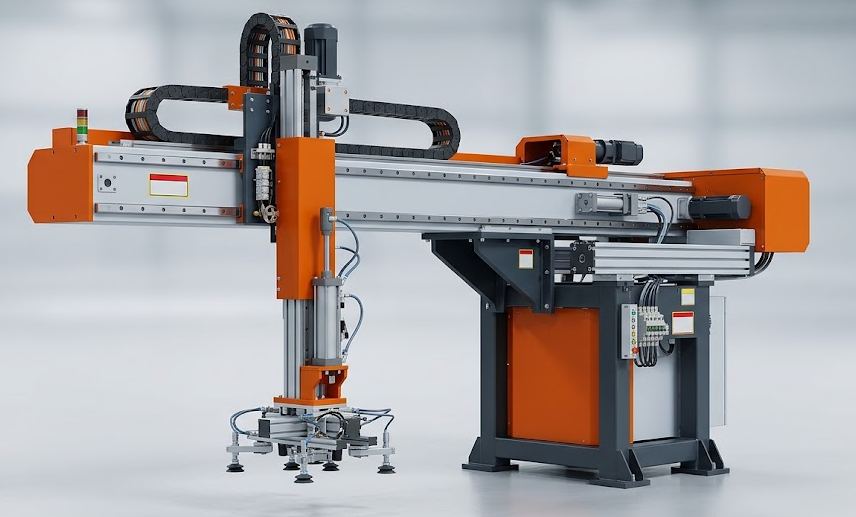
A practical guide to robot selection, integration and repeatable part handling
Table of Contents
· What the robot must do
· 1. Match the robot to the molding cell
· 2. Design the end-of-arm tooling
· 3. Evaluate speed, motion and safety
· 4. Plan integration and downstream handling
· 5. Approve the project with a realistic trial
· Illustrative application scenario
An injection molding take out robot manufacturer supplies more than a robot arm. The useful solution is a coordinated system that removes molded parts safely, protects the mold, meets the cycle target and hands parts to the next operation. Selection should begin with the molding machine, mold layout, part geometry and downstream process. The Mengsu website identifies Shanghai Mengsu Automation Machinery Co., Ltd. and presents injection molding machinery and automation-related products; exact robot models, payloads and cycle figures should be confirmed directly.
What the robot must do
A take out robot enters the mold area, grips or picks the part, exits without collision and places it at a defined location. It may serve a simple drop chute, conveyor, trimming station, inspection fixture or packing line. The robot is only successful when the complete sequence is stable.
Start with the molded part and the machine, not with an advertised axis count. Note part weight, shape, gate location, runner, ejection direction, mold opening, insertion depth, cycle time, cooling needs and the required placement orientation.
1. Match the robot to the molding cell
Provide machine size, tie-bar spacing, mold dimensions, mold weight, platen height, maximum opening, ejection stroke and controller interface. Confirm whether the robot mounts above the machine or beside it and how operators access the cell.
The part may need a simple vertical pick, a rotation, a two-stage motion or a separate runner grip. Fragile edges, visible surfaces, inserts and hot parts change the end-of-arm design. A supplier should review interference with mold, guards, water lines and safety devices.
For buyers searching “servo take out robot for injection molding” or “custom injection molding automation system,” these details separate a usable inquiry from a generic request.
2. Design the end-of-arm tooling
The gripper is often the most application-specific element. Vacuum cups, mechanical fingers, magnetic elements or a combination may be suitable, depending on resin, surface, temperature, texture and part stiffness. Runner and part may need separate grip points.
Tooling should hold the part without marks and release it at the target position. Keep the tool light enough for the robot and rigid enough to avoid vibration. Provide quick-change references when the cell will run several molds, but verify that changeover repeatability is acceptable.
Test the actual parts, including variation from molding. A tool that works on a perfect sample may struggle with flash, warpage, short shots or a different cooling condition.
3. Evaluate speed, motion and safety
Cycle time should be calculated from the whole sequence: mold open, entry, grip, extraction, exit, placement and return. Faster motion is not always better if it creates vibration, collision risk or inconsistent release. Ask for a cycle study using the customer’s mold and part.
Safety includes guarded access, interlocks, emergency stops, safe recovery and clear manual-mode procedures. The robot must not encourage operators to reach into the mold area. Clarify who is responsible for integrating the robot with the machine safety circuit.
Use a repeatable test plan. Record successful picks, missed picks, placement accuracy, recovery steps and operator changeover time rather than relying only on a headline cycle number.
4. Plan integration and downstream handling
A take out robot may place parts on a conveyor, in a fixture, into a cooling nest or into a packaging station. Define orientation, spacing, counting, reject handling and signal exchange. If the next process needs vision or trimming, reserve space and provide a clear handoff.
Confirm electrical, pneumatic and communication requirements, utilities, mounting, teach pendant access and documentation. The quotation should distinguish standard scope from customer-supplied conveyors, tooling, guarding or installation work.
For a custom injection molding robot manufacturer, commissioning support and troubleshooting access can matter as much as the arm itself. Ask how programs are backed up and how future molds are added.
5. Approve the project with a realistic trial
A sample trial should use the actual mold, parts and target sequence where possible. Approve grip, extraction, placement, cycle stability, safety functions, changeover and packaging interface. Record open items before shipment.
Do not accept unverified claims about payload, precision, speed or compatibility. Ask for a layout, tooling drawing, risk review, utility list and acceptance criteria. Exact capabilities should be written into the technical agreement.
Illustrative application scenario
A packaging producer wants to remove a thin molded lid, separate the runner and place lids in aligned rows. The integrator tests a soft-contact gripper, checks mold clearance, adds a reject position and validates row spacing on the customer’s conveyor. This is illustrative, not a reported Mengsu project.
Frequently Asked Questions
What information is needed for a quotation?
Provide machine details, mold drawing, part and runner samples, weight, cycle target, extraction direction, placement method, utilities and safety requirements.
Is a three-axis robot always enough?
Not necessarily. It depends on mold layout, part orientation, rotation, placement and downstream handling. Select motion from the sequence, not a generic axis label.
Can one robot handle several molds?
It may, if tooling, programs, reach, payload and changeover method are designed for it. Validate each mold and approve the changeover process.
Why is end-of-arm tooling important?
It determines grip reliability, marks, release, collision risk and changeover time. The tool should be tested with real parts and normal process variation.
Conclusion
Choose an injection molding take out robot manufacturer by reviewing the whole cell: machine, mold, part, gripper, motion, safety and downstream handoff. A practical trial and written acceptance criteria create a stronger basis than a generic speed claim.