
July 14, 2026
Injection Molding Robot Arm vs. Manual Operation: Which One Is Right for You?
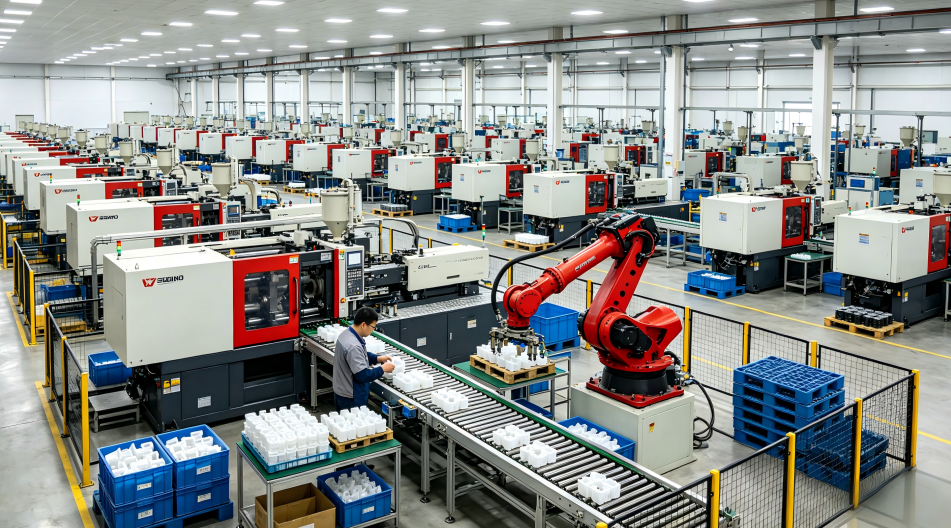
Table of Contents
1. Introduction
2. The Reality on the Shop Floor Today
3. What the Numbers Actually Say
4. The Human Factor: What Manual Operation Really Costs
5. Beyond Speed: Quality, Consistency, and Scrap Reduction
6. Real-World Case Study: From 83 Seconds to 22 Seconds
7. When Does a Robot Arm Make Sense?
8. When Does Manual Operation Still Work?
9. The Hidden Costs Nobody Talks About
10. Frequently Asked Questions
11. Final Thoughts
1. Introduction
I've been in and out of injection molding shops for long enough to know that the question isn't really about whether robots are "better" than people. That's the wrong way to frame it.
The real question is: what does your production actually need?
I've walked into facilities where a simple manual operation was working just fine—and I've walked into others where the lack of automation was bleeding money and quality every single shift. The difference isn't always obvious from the outside.
Here's what I've learned over the years. An injection molding robot arm can do things that human hands simply cannot sustain over time. But that doesn't mean every shop needs one tomorrow. The decision comes down to volume, part complexity, quality requirements, and—this one surprises a lot of people—the availability of skilled labor in your area.
Let me walk you through what I actually see on the ground. No marketing fluff. Just the numbers, the trade-offs, and some hard-earned experience.
2. The Reality on the Shop Floor Today
Walk into any injection molding plant and you'll see a mix. Some cells running fully automated with injection molding robot arms humming away cycle after cycle. Others still relying on operators reaching into the mold area to pull parts out by hand.
The trend, though, is unmistakable.
The global plastic injection machine robotic arm market was valued at USD 4.99 billion in 2025 and is projected to reach USD 7.29 billion by 2032, growing at a CAGR of 5.55%. That's not a small niche. That's a fundamental shift in how the industry is equipping itself.
Why? Because the pressures are real.
Labor shortages aren't getting better. In fact, in many regions they're getting worse. The manufacturing workforce is aging, younger workers aren't lining up for repetitive, physically demanding jobs, and the cost of labor keeps climbing. At the same time, customers are demanding tighter tolerances, faster delivery, and full traceability.
An injection molding robot arm addresses a lot of these pressures at once. It doesn't take breaks. It doesn't get tired. It doesn't have off days. And it removes the operator from the mold area—which, if you've ever seen a mold close on someone's hand, you know is a pretty significant benefit on its own.
3. What the Numbers Actually Say
Let's get specific. I'm going to share some numbers from actual studies and implementations. These aren't marketing claims—they're peer-reviewed and documented.
A study published in the Journal of the Korean Society of Mechanical Technology examined the transition from manual to automated injection molding for producing moving hanger mounts. Here's what they found:
Metric | Manual Process | Automated Process | Improvement |
Cycle Time | 83 seconds | 22 seconds | 73% reduction |
Hourly Production Output | Baseline | +23% | 23% increase |
Defect Rate | 25% | 15% | 40% reduction |
Manual Labor Hours | Baseline | -82% | 82% reduction |
Source: Journal of the Korean Society of Mechanical Technology, Vol. 23, No. 12, 2024
The economic analysis projected annual savings of approximately 93.5 million KRW (around $70,000 USD), with an ROI of 69.07% and a payback period of just 1.43 years.
I want you to sit with those numbers for a second. A 73% reduction in cycle time. An 82% reduction in manual labor hours. A 40% reduction in defects. And a payback in under a year and a half.
Those aren't outliers, either. Another study on automating ball valve production for the automotive industry found that a robotic arm for injection molding improved cycle time by more than 30% and reduced the defect rate by over 70%.
So when someone tells you automation is expensive and the ROI isn't there—well, the data says otherwise.
4. The Human Factor: What Manual Operation Really Costs
Here's something that doesn't always show up in the spreadsheets.
Manual part removal isn't just slower. It's variable.
An operator's reaction time varies. Their grip strength varies. Their attention level varies over the course of a shift. And all of that variation introduces inconsistency into the process.
A SEAWIN INDUSTRIAL analysis of manual versus robotic injection molding found that manual operators add an average of 5 to 10 seconds per cycle just from slower reaction times. That might not sound like much. But over an 8-hour shift, at a 30-second cycle, you're losing anywhere from 800 to 1,600 parts. Per machine. Per day.
The labor math is also pretty stark. Using Vietnam as an example, a six-axis robotic system (approximately $50,000 investment) can replace three operators at a monthly salary of around $350 per person, resulting in annual labor cost savings of about $12,600. In higher-wage markets, those savings multiply significantly.
But here's the thing—and I want to be careful here because I'm not anti-labor—the goal isn't to replace people. The goal is to move people to higher-value work. Instead of standing at a machine pulling parts for eight hours, an operator can oversee multiple cells, handle quality checks, or perform maintenance. That's a better use of human capability, and frankly, most operators prefer it.
5. Beyond Speed: Quality, Consistency, and Scrap Reduction
Speed is the headline number, but quality is where the real money lives.
A fully automated injection molding robot arm achieves repeatability of ±0.02mm, maintaining CPK values stably above 1.67. Manual operation typically keeps CPK below 1.33, which often isn't sufficient for precision parts.
What does that mean in plain English? It means the robot places the part in exactly the same position, with exactly the same force, every single time. No variation. No drift. No fatigue-induced errors.
The defect rate difference is significant. Robotic systems typically control defects below 0.5%, while manual operations see defect rates ranging from 2% to 5%.
I've seen shops where a 3% defect rate was considered "normal." That's 3 out of every 100 parts going to scrap. On a machine running 10,000 parts a day, that's 300 scrapped parts per day. Over a year, that's tens of thousands of dollars in wasted material alone—not to mention the lost machine time, the rework, and the customer dissatisfaction.
Manual handling also introduces surface quality issues. Fingerprints, scratches, deformation from uneven gripping—these are all problems that disappear when you use a properly designed injection molding robot arm with appropriate end-of-arm tooling. For high-gloss or transparent parts, this is often the deciding factor.
6. Real-World Case Study: From 83 Seconds to 22 Seconds
Let me share a specific example that really illustrates what's possible.
A study documented the automation of an injection molding process for moving hanger mounts in garment care systems. The manual process had been running for years. Operators would wait for the mold to open, reach in, pull out the part, and repeat. Cycle time: 83 seconds. Defect rate: 25%.
The company implemented an articulated robotic arm for injection molding to handle the entire removal and transfer process.
The results:
Cycle time dropped from 83 seconds to 22 seconds—a 73% reduction
Hourly production output increased by 23%
Defect rate fell from 25% to 15%—a 40% improvement in quality
Manual labor hours were cut by 82%
Annual savings: approximately 93.5 million KRW
ROI: 69.07%
Payback period: just 1.43 years
Here's what I find interesting about this case. The company wasn't some massive multinational with unlimited capital. They were a mid-sized manufacturer facing the same pressures everyone else faces: rising labor costs, quality issues, and pressure to deliver more parts faster.
The injection molding robot arm didn't just improve one metric. It improved every single metric that matters—speed, quality, labor, and cost.
7. When Does a Robot Arm Make Sense?
Based on what I've seen across dozens of facilities, here's when an injection molding robot arm is usually the right call.
High-volume production. If you're running the same part for thousands or millions of cycles, the consistency and speed of a robot arm pay for themselves quickly. The ROI math gets better with every cycle.
Complex or delicate parts. If your parts are easily damaged by manual handling—high-gloss surfaces, thin walls, complex geometries—a robot arm with custom end-of-arm tooling can handle them more gently and consistently than human hands.
Multi-cavity molds. Pulling 4, 8, or 16 parts from a single mold by hand is slow and awkward. A robot arm can remove all cavities simultaneously in a fraction of a second. Yushin demonstrated this at the K Show, removing 16 parts from a mold in 0.27 seconds.
Safety concerns. If your process involves hot parts, sharp edges, or tight mold areas, getting human hands out of the equation is a significant benefit.
Labor shortages. This is becoming the #1 driver in many regions. If you can't find reliable operators—or the ones you have are costing you more every year—automation becomes a necessity, not a luxury.
24/7 operations. A robotic arm for injection molding doesn't need breaks, doesn't call in sick, and doesn't require shift handovers. It runs.
8. When Does Manual Operation Still Work?
I want to be balanced here. Manual operation isn't always the wrong choice.
Low-volume or short-run production. If you're running a few hundred parts and then changing over to something completely different, the setup time and programming for a robot arm might not be worth it.
Prototyping and development. When you're still dialing in the process, having a human operator who can see, feel, and adjust in real time can be valuable. Some shops use a hybrid approach—manual during development, automated once the process is stable.
Very simple parts with forgiving tolerances. If you're making simple parts where surface finish isn't critical and cycle time isn't the bottleneck, manual operation might still be cost-effective.
Budget constraints. Not every shop has the capital for a $50,000 or $100,000 automation investment. That said, payback periods are getting shorter. Some systems, like the igus robolink, can pay for themselves in as little as four months.
The key is to do the math for your specific situation. Don't assume manual is cheaper just because the upfront cost is lower. And don't assume automation is always the answer just because it's trendy.
9. The Hidden Costs Nobody Talks About
Let me share some things that don't always make it into the sales pitch.
Programming and setup. A robot arm doesn't program itself. You need someone who understands the system, can set up the end-of-arm tooling, and can troubleshoot when things go wrong. This is a skill gap that many shops underestimate.
Maintenance. Robots need maintenance. Bearings wear out. Cables fatigue. Sensors drift. If you don't have a maintenance plan, you'll have unplanned downtime.
End-of-arm tooling. The robot arm is only half the equation. The tooling that actually grips the part needs to be designed, fabricated, and maintained. This is often overlooked in the initial budget.
Integration. A robot arm doesn't work in isolation. It needs to communicate with the injection molding machine, the conveyor, the quality inspection system, and potentially other equipment. Integration takes time and expertise.
Changeover time. If you're running multiple products, you need to account for changeover time—swapping end-of-arm tooling, loading new programs, and validating the setup. Some modern systems with modular designs have made this much faster, but it's still a factor.
I'm not saying these costs make automation a bad choice. I'm saying you need to budget for them realistically.
10. Frequently Asked Questions
Q: How much does an injection molding robot arm cost?
A: It varies widely. A basic servo traverse robot for a small press might cost $15,000–$25,000. A six-axis articulated robot for a large automotive press can run $50,000–$100,000 or more. The total system cost—including end-of-arm tooling, integration, and programming—is typically 25% to 30% higher than the robot itself.
Q: How long does it take to pay back the investment?
A: Based on documented implementations, payback periods range from four months to about two years. The igus robolink system, for example, has documented payback in four months. A peer-reviewed study found a 1.43-year payback with 69% ROI.
Q: Can I retrofit a robot arm to my existing injection molding machine?
A: Yes, in most cases. Many suppliers offer retrofit solutions that can be installed on existing presses. However, the integration is typically smoother when the robot and the machine are designed to work together from the start.
Q: Do I need a skilled programmer to operate it?
A: Modern servo robots have become much more user-friendly. Many systems feature intuitive touchscreen interfaces that allow operators to teach positions and set up programs without deep programming knowledge. That said, having someone on staff who understands the system is still valuable.
Q: What's the difference between a 3-axis and a 5-axis robot arm?
A: A 3-axis robot moves in X, Y, and Z directions—forward/back, up/down, and left/right. A 5-axis robot adds rotation capabilities, allowing it to tilt and turn the part for more complex handling or placement. For most standard pick-and-place applications, 3-axis is sufficient. For parts that need to be oriented or inserted at angles, 5-axis is the better choice.
11. Final Thoughts
Here's what I've come to believe after years of watching shops make this decision.
An injection molding robot arm isn't about replacing people. It's about creating a production process that's faster, more consistent, and less dependent on variables you can't control. The data is clear: automation reduces cycle time, cuts defects, lowers labor costs, and delivers strong ROI.
But—and this is important—it's not for everyone.
If you're running low volumes, simple parts, and you have reliable operators, manual operation might still be the right call. At least for now.
The trend, though, is unmistakable. The market for injection molding robot arms is growing at 5.55% annually and is expected to reach $7.29 billion by 2032. The injection molding automation solutions market is growing even faster, at 8.4% CAGR. Manufacturers are adopting these systems because they work—not because they're trendy.
My advice? Run the numbers for your specific operation. Look at your cycle time, your defect rate, your labor costs, and your volume. Then decide.
But don't assume manual is cheaper just because it's what you've always done. The math might surprise you.