
October 19, 2026
Injection Molding Take Out Robot Quality Control and Acceptance Guide
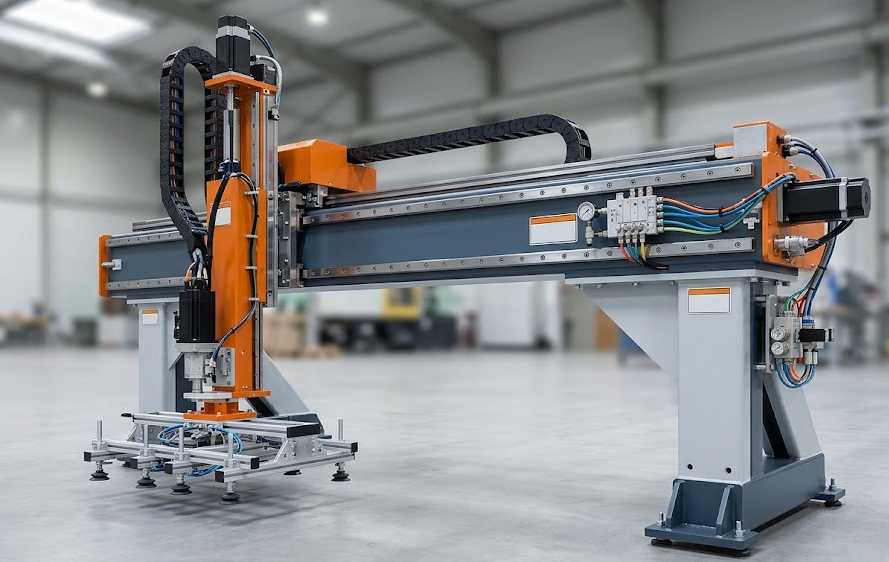
How to verify extraction, gripping, safety and repeatable production before handover
Table of Contents
· Why cell-level quality control matters
· 1. Verify the approved inputs
· 2. Inspect gripper and extraction behavior
· 3. Test motion, interlocks and recovery
· 4. Validate placement and downstream signals
· 5. Complete documentation and handover
· Illustrative acceptance scenario
Quality control for an injection molding take out robot covers the complete cell, not just the robot cabinet. The mold, end-of-arm tooling, machine interface, guarding, programs and downstream placement must work together under normal production variation. This guide gives buyers a practical acceptance framework without inventing model-specific ratings.
Why cell-level quality control matters
A robot can move accurately in a demonstration and still fail in production because parts vary, the mold opens differently, the gripper loses vacuum or the conveyor is not ready. Acceptance should therefore use the real mold, normal material and planned operating method.
Define measurable results: successful picks, correct placement, safe recovery, changeover time, reject handling, alarm response and documentation.
1. Verify the approved inputs
Confirm robot layout, mold dimensions, machine signals, part and runner samples, tool drawing, target cycle, utilities, guarding and operator access. Any change to mold, part, resin or downstream equipment should be reviewed before testing.
Check that the approved program and tooling revision match the physical cell. Record assumptions such as estimated part weight or provisional cycle time and replace them with verified values.
2. Inspect gripper and extraction behavior
Inspect contact points, vacuum lines, fingers, sensors, tubing protection and quick-change references. The tool should grip intended surfaces without cosmetic damage and release reliably at the destination.
Run repeated picks with normal variation, including acceptable flash, warpage or temperature differences. Check runner separation, part orientation, missed-pick detection and safe handling of a failed extraction.
3. Test motion, interlocks and recovery
Run the complete sequence at production conditions. Observe entry, grip, extraction, exit, placement and return. Check clearances around mold, guards, hoses, cores and ejectors.
Test door interlocks, emergency stops, safe manual mode, alarm messages, restart procedure and power recovery. Operators should know how to clear a part and resume without entering an unsafe zone.
4. Validate placement and downstream signals
Confirm conveyor pitch, fixture location, counting, row spacing, reject position and handoff signals. If a packing or inspection station follows, run long enough to expose accumulation and timing problems.
Record cycle data from the complete cell, not only robot travel. A stable slower cycle may be more valuable than a short demonstration that causes downstream congestion.
5. Complete documentation and handover
The release file should include layout, tooling drawing, electrical and pneumatic diagrams, program backup, spare-parts list, maintenance points, safety instructions, acceptance results and open-item ownership.
For repeat production, define change control for new molds, gripper revisions, software edits and sensor substitutions. Keep retained samples and a clear escalation route for missed picks, marks or placement drift.
Illustrative acceptance scenario
A robot cell is tested with a multi-cavity household part. The team checks cavity identification, runner removal, grip marks, row placement and recovery from a simulated missed pick. One sensor position is corrected and the final program is backed up before handover. This is illustrative, not a reported Mengsu result.
Practical release checks
Before handover, compare the physical cell with the approved layout and tooling drawing. Confirm that the robot can be isolated, that operators can see the pickup and placement areas, and that routine cleaning does not disturb sensors, vacuum lines or gripper fingers.
Run a restart test after a controlled stop. The recovery path should identify whether a part remains in the mold, gripper or conveyor and should prevent double picking. Record the alarm text, operator action and time needed to return to production.
Review maintenance access as well as production performance. Lubrication points, filters, cables, vacuum generators, sensors and spare fingers should be reachable without dismantling unrelated equipment. A clear preventive-maintenance schedule protects repeatability after commissioning.
Also review the handoff to production staff. Operators should understand how to select an approved mold program, confirm tooling identity, adjust only authorized settings and report a recurring alarm. Simple instructions reduce the temptation to bypass a sensor or change a timing value without recording it.
For a multi-mold cell, keep a changeover checklist covering gripper installation, program selection, signal verification, first-piece approval and safe storage of unused tooling. This makes a flexible robot easier to manage and gives the manufacturer useful evidence when troubleshooting.
Frequently Asked Questions
What should a robot FAT or SAT include?
Use the actual mold and parts where possible, and test picking, placement, cycle stability, safety, alarms, recovery, changeover and documentation.
How many cycles are enough for acceptance?
There is no universal number. Agree a representative run based on risk, variation, production target and customer quality requirements.
What causes missed picks?
Common causes include part variation, weak vacuum, unsuitable contact points, timing, temperature, mold ejection behavior and sensor settings. Diagnose the complete sequence.
Who should approve safety integration?
The machine owner and qualified safety personnel should review the cell against applicable local requirements and the agreed risk assessment.
Conclusion
A reliable take out robot is proven through repeatable extraction, safe motion, stable placement and clear documentation. Use a cell-level acceptance test with the real mold and production sequence, then control future changes through approved programs and tooling records.