
September 18, 2026
OEM and Custom Automation: What to Look for in a Take Out Robot Supplier
I have been sourcing take out robots and injection molding automation for over a decade, and I can tell you that the most expensive mistake in this category is selecting the robot on its specifications and ignoring the supplier who integrates it.
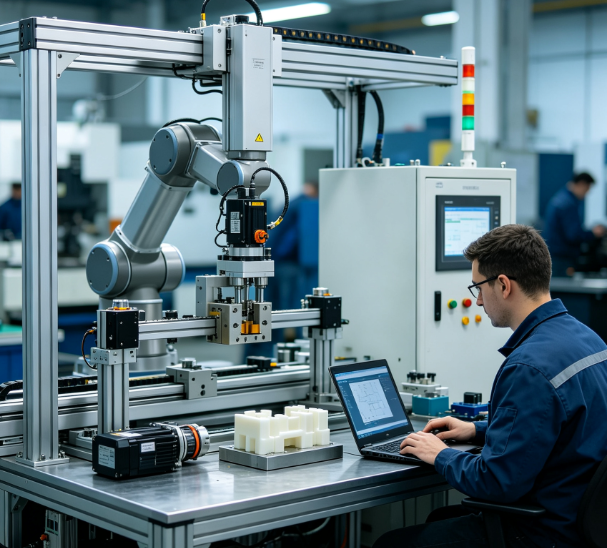
1. Introduction: The Robot Is Only Half the System
I have been sourcing take out robots and injection molding automation for over a decade, and I can tell you that the most expensive mistake in this category is selecting the robot on its specifications and ignoring the supplier who integrates it.
Here is what that looks like in practice. A molder buys a standard 3-axis servo take out robot from a catalog supplier. The robot has the right payload, the right stroke, and the right price. It arrives. The mounting plate does not match the platen pattern on the molding machine. The end-of-arm tooling has to be redesigned because the standard gripper cannot handle the part geometry. The Euromap interface cable is the wrong pin configuration. The installation takes three weeks instead of three days. And the molder discovers that the catalog supplier does not provide on-site integration support — they sell robots, not solutions.
The take out robot is not a standalone product. It is a component in a system that includes the molding machine, the end-of-arm tooling, the conveyor, the granulator, and the downstream packaging. The supplier who understands that system — and who can customize the robot and the tooling to fit it — is worth more than the supplier who simply ships a standard unit at the lowest price.
The global injection molding machine market was valued at approximately USD 18.5 billion in 2025 and is projected to grow at a CAGR of 4.5% through 2033. The take out robot segment — also called part removal robots or sprue pickers — represents a significant portion of the automation attachment market. As molders face labor shortages, quality demands, and cycle time pressure, the take out robot is moving from optional accessory to essential production equipment.
This guide breaks down the supplier selection decision — the specifications, the tooling, the interfaces, the safety requirements, and the evaluation framework that separates a robot vendor from an automation partner.
2. What a Take Out Robot Actually Does
A take out robot — also called a part removal robot, sprue picker, or traverse robot — is a Cartesian or articulated robot mounted on the stationary platen of an injection molding machine. Its function is to enter the mold area after the mold opens, grip the molded part (or the sprue, or both), extract it from the mold, and transfer it to a conveyor, a bin, or a downstream operation.
The basic sequence is:
Mold opens — the moving platen retracts, separating the mold halves
Robot enters — the arm extends into the space between the mold halves
Grip — the end-of-arm tooling grips the part and/or the sprue
Extract — the arm retracts, pulling the part out of the mold
Traverse — the arm moves laterally to the drop position
Release — the tooling releases the part onto a conveyor or into a bin
Return — the arm returns to the home position, ready for the next cycle
The robot must complete this sequence within the mold-open time of the molding cycle. If the robot is too slow, the molding machine waits — and the cycle time increases. If the robot is too fast, it may not have enough time to grip securely — and the part may be dropped or damaged. The cycle time match between the robot and the molding machine is the most important performance requirement.
Beyond the basic sequence, modern take out robots perform additional functions: sprue separation (cutting or breaking the sprue from the part), part orientation (rotating the part for downstream handling), quality inspection (vision systems or weight checking), and packaging (placing parts directly into trays or bags).
3. Standard OEM Robots vs. Custom Automation: The Real Difference
The take out robot market has two distinct supplier categories, and they serve different needs.
Standard OEM robot suppliers manufacture a catalog of robots in standard sizes and configurations. They sell through distributors or directly to molders. Their strength is volume production — standardized designs, documented specifications, off-the-shelf availability, and competitive pricing. Their limitation is flexibility. A standard robot has a fixed stroke length, a fixed payload, a fixed mounting pattern, and a standard end-of-arm tooling interface. If the molder's application does not fit the standard envelope, the supplier may not be able to help.
Custom automation suppliers design and build the robot and the tooling around the specific application. They start with the part geometry, the mold layout, the molding machine, and the downstream requirements, then engineer the solution. Their strength is fit — the robot matches the application, not the other way around. Their limitation is cost and lead time. A custom solution costs more than a standard robot and takes longer to deliver.
The distinction is not always clear. Many OEM robot suppliers offer some level of customization — longer strokes, special mounting plates, modified controls. And many custom automation suppliers use standard robot components as building blocks for their custom systems. The practical question is not "OEM or custom" but "how much customization does my application actually require?"
Parameter | Standard OEM Robot | Custom Automation Solution |
Design basis | Catalog standard | Application-specific |
Stroke length | Fixed range | Engineered to application |
Payload | Fixed range | Engineered to part weight |
Mounting | Standard platen pattern | Custom adapter plate |
End-of-arm tooling | Standard gripper | Custom-designed gripper |
Machine interface | Standard cable | Custom pin configuration |
Lead time | 2–6 weeks | 6–16 weeks |
Unit cost | Lower | Higher |
Integration support | Limited | Full |
Best for | Standard parts, standard molds | Complex parts, unusual molds, high-mix |
4. The Five Specifications That Determine Fit
The take out robot must fit the molding machine, the mold, the part, and the production schedule. Five specifications determine whether it will.
Payload. The payload is the maximum weight the robot can carry at the end of its arm, including the end-of-arm tooling and the part. The payload must account for the dynamic loads during acceleration and deceleration — not just the static weight of the part. A robot rated at 5 kg payload can typically handle a 2–3 kg part plus a 1–2 kg gripper, but the acceleration profile may reduce the effective payload further. The payload specification should be at least 1.5 times the combined weight of the tooling and the heaviest part.
Stroke length. The stroke is the distance the robot arm travels in each axis. The vertical stroke must be enough to clear the mold halves and lift the part above the tie bars. The horizontal stroke must be enough to reach the drop position. The traverse stroke must be enough to move the part clear of the mold area. For a standard 100–300 ton molding machine, the vertical stroke is typically 600–1,200mm, the horizontal stroke 400–800mm, and the traverse stroke 600–1,500mm.
Speed and acceleration. The robot must complete its sequence within the mold-open time. The critical speed is the traverse speed — how fast the robot moves from the mold area to the drop position. A standard take out robot traverses at 1.5–3.0 m/s, with acceleration of 5–15 m/s². The cycle time calculation must include the acceleration and deceleration ramps, not just the steady-state speed.
Repeatability. The repeatability is the robot's ability to return to the same position over multiple cycles. For take out robots, the typical repeatability is ±0.1mm to ±0.5mm. The requirement depends on the part geometry and the end-of-arm tooling. A part that must be placed precisely on a conveyor or into a fixture requires tighter repeatability than a part that is dropped into a bin.
Mounting interface. The robot mounts to the stationary platen of the molding machine. The mounting pattern must match the platen's bolt hole pattern, and the robot's mounting plate must have the correct dimensions and hole spacing. Most molding machines follow Euromap or SPI mounting standards, but older machines or specialty machines may have non-standard patterns. The supplier must confirm the mounting interface before the robot is built.
Specification | Typical Range | Determines | Verification |
Payload | 1–20 kg | Gripper and part weight capacity | Calculation with 1.5× safety factor |
Vertical stroke | 600–1,200 mm | Mold clearance | Mold height + part height + clearance |
Horizontal stroke | 400–800 mm | Drop position reach | Distance from mold to conveyor |
Traverse stroke | 600–1,500 mm | Mold area clearance | Tie bar spacing + clearance |
Speed | 1.5–3.0 m/s | Cycle time match | Mold-open time calculation |
Repeatability | ±0.1–0.5 mm | Placement accuracy | Part and fixture tolerance |
Mounting | Euromap / SPI / custom | Physical fit | Platen bolt pattern measurement |
5. End-of-Arm Tooling: Where Custom Suppliers Earn Their Keep
The end-of-arm tooling — the gripper, the vacuum cups, the sprue cutter, the part holder — is where the take out robot either succeeds or fails. And it is the component that standard OEM suppliers are least equipped to provide.
The end-of-arm tooling must:
Grip the part securely without marking, deforming, or damaging it
Release the part reliably at the drop position
Handle the sprue if the sprue is removed separately from the part
the part geometry — flat parts, cylindrical parts, parts with undercuts, parts with delicate features
Fit within the mold area without interfering with the mold halves, the ejector pins, or the core pulls
Survive the mold environment — heat, moisture, and repeated cycling
The tooling design starts with the part drawing and the mold layout. A custom automation supplier will review the part geometry, the gate location, the ejector pin pattern, and the mold opening stroke, then design a gripper that reaches the part, grips it without damage, and extracts it without interference.
Common gripper types include:
Vacuum cups — for flat, smooth parts; simple and low-cost, but require a clean, non-porous surface
Mechanical grippers — for parts with features that can be gripped; pneumatic or electric actuation
Magnetic grippers — for ferrous inserts or overmolded metal components
Specialty grippers — for parts with unusual geometry, such as internal expanding grippers or articulated fingers
A custom supplier will often build the gripper as a dedicated assembly — designed for the specific part, machined from aluminum or steel, with quick-change features for maintenance. The standard OEM gripper, by contrast, is a generic design that may or may not fit the part. The difference in grip reliability, part damage, and cycle time can be significant.
Tooling Factor | Standard OEM Gripper | Custom-Designed Gripper |
Part fit | Generic — may not match | Engineered to part geometry |
Grip security | Variable | Verified with force calculation |
Part marking risk | Higher | Controlled with soft-touch materials |
Cycle time | Slower — may need repositioning | Optimized for fastest extraction |
Changeover | Manual adjustment | Quick-change or dedicated |
Cost | Lower | Higher |
Best for | Standard parts, single product | Complex parts, high-mix, critical surface |
6. Machine Interface and Communication Standards
The take out robot must communicate with the molding machine. The molding machine tells the robot when the mold is open. The robot tells the molding machine when it is clear of the mold area. If the communication fails or is delayed, the molding machine may close on the robot — a catastrophic collision.
Euromap is the standard interface for injection molding machine communication. Euromap 67 (also called Euromap 67/1) defines the electrical interface between the molding machine and the handling device. It specifies the connector type, the pin assignment, and the signal protocol. A take out robot with a Euromap 67 interface can be connected to any molding machine that supports the standard — which includes most modern machines from European, Japanese, and North American manufacturers.
SPI (Society of the Plastics Industry) is the North American equivalent. SPI AN-146 defines the interface between the molding machine and the robot. Some machines support both Euromap and SPI; others support only one. The supplier must confirm the interface standard before the robot is built.
The interface signals. The critical signals between the molding machine and the take out robot include:
Mold open — the signal from the machine to the robot that the mold is open and the robot can enter
Robot in position — the signal from the robot to the machine that the robot is clear of the mold area
Robot fault — the signal from the robot to the machine that a fault has occurred
Emergency stop — the signal that stops both machines
The interface cable must be the correct length, the correct pin configuration, and the correct shielding. A cable that is too short, wired incorrectly, or unshielded can cause intermittent faults that are difficult to diagnose.
Interface Standard | Region | Connector Type | Key Signals |
Euromap 67 | Europe, global | 32-pin Harting | Mold open, robot clear, fault, e-stop |
SPI AN-146 | North America | 24-pin | Mold open, robot clear, fault, e-stop |
Custom | Any | Application-specific | Defined by machine builder |
7. Safety Compliance: The Non-Negotiable Requirements
The take out robot operates inside the molding machine's safety envelope. The robot and the molding machine must be integrated into a single safety system that prevents the robot from entering the mold area while the mold is closing, and prevents the mold from closing while the robot is in the mold area.
ISO 10218-1 and -2:2025 are the international standards for industrial robot safety. ISO 10218-1 covers the robot itself; ISO 10218-2 covers the robot system and integration. The 2025 revision includes updated requirements for collaborative applications and functional safety.
ANSI/RIA R15.06 is the U.S. equivalent. It covers the safety requirements for industrial robots and robot systems, including the risk assessment, the safeguarding, and the verification of safety functions.
ISO/TS 15066 applies to collaborative robot systems. If the take out robot operates in a collaborative mode — sharing the workspace with a human operator — this standard applies.
For the take out robot supplier, the critical safety deliverables are:
Risk assessment — a documented assessment of the hazards and the risk reduction measures
Safety-rated control — the robot's safety functions (e-stop, protective stop, speed limiting) must be designed to the appropriate safety integrity level (SIL or PL)
Interface safety — the signals between the robot and the molding machine must be designed so that a single fault cannot cause a hazardous condition
Documentation — the safety manual, the wiring diagram, and the verification records
A supplier who cannot provide a risk assessment and safety-rated control documentation is not a qualified take out robot supplier for a production environment.
8. Head-to-Head: Standard OEM vs. Custom Automation Supplier
Parameter | Standard OEM Robot Supplier | Custom Automation Supplier |
Design approach | Catalog standard | Application-specific |
Robot type | Cartesian, 3-axis or 5-axis | Cartesian, articulated, or hybrid |
Payload range | Fixed standard sizes | Engineered to application |
Stroke range | Fixed standard sizes | Engineered to mold and machine |
End-of-arm tooling | Standard gripper or none | Custom-designed and built |
Machine interface | Standard Euromap or SPI cable | Custom pin configuration and cable |
Integration support | Limited — documentation only | Full — on-site commissioning |
Risk assessment | Generic template | Application-specific |
Lead time | 2–6 weeks | 6–16 weeks |
Unit cost | Lower | Higher |
Best for | Standard parts, standard molds, single product | Complex parts, unusual molds, high-mix, critical surface |
9. Supplier Evaluation Framework: The Questions That Reveal Capability
The supplier's answers to these questions reveal whether they are a robot vendor or an automation partner.
Question 1: Can you provide a risk assessment for my specific application? A standard supplier will provide a generic safety manual. A custom supplier will provide a risk assessment that addresses the specific hazards of your mold, your part, and your machine.
Question 2: How do you design the end-of-arm tooling? A standard supplier will ask you to select from a catalog of grippers. A custom supplier will ask for the part drawing, the mold layout, and the gate location — then design the gripper.
Question 3: How do you verify the cycle time match? A standard supplier will quote a speed specification. A custom supplier will calculate the cycle time for your specific sequence, including acceleration, deceleration, and grip time.
Question 4: What is your mounting interface verification process? A standard supplier will ask you to confirm the platen pattern. A custom supplier will ask for the machine make and model, look up the platen drawing, and verify the bolt pattern before the robot is built.
Question 5: What is your on-site support policy? A standard supplier will provide installation documentation. A custom supplier will send a technician to commission the system, train the operators, and verify the cycle time.
Question 6: Can you integrate the robot with my downstream equipment? A standard supplier will provide a robot with I/O. A custom supplier will integrate the robot with the conveyor, the granulator, the vision system, and the packaging equipment.
Evaluation Question | Standard Supplier Answer | Custom Supplier Answer |
Risk assessment | Generic safety manual | Application-specific risk assessment |
Tooling design | Catalog selection | Custom design from part drawing |
Cycle time | Speed specification | Calculated cycle time for your sequence |
Mounting verification | Customer confirms | Supplier verifies from machine drawing |
On-site support | Documentation only | On-site commissioning and training |
Downstream integration | Robot I/O only | Full system integration |
10. Total Cost of Ownership: What the Quotation Doesn't Show
The purchase price of the take out robot is the visible cost. The total cost of ownership includes the costs that appear after installation.
Installation and commissioning. A standard robot may require the molder's maintenance team to design the mounting adapter, fabricate the interface cable, and program the sequence. A custom supplier delivers a system that is ready to run. The installation labor difference can be 40–80 hours of engineering and maintenance time.
End-of-arm tooling. A standard gripper may not fit the part. The molder may need to design and build a custom gripper separately — at a cost of $2,000–$10,000 and a lead time of 4–8 weeks. A custom supplier includes the tooling in the system price.
Cycle time optimization. A standard robot may not achieve the optimal cycle time. The molder may need to run the molding machine slower to accommodate the robot. A custom supplier optimizes the robot and the tooling for the fastest cycle time. The production cost difference over a year can be substantial.
Downtime and maintenance. A standard robot with a generic gripper may experience more dropped parts, more gripper wear, and more unplanned downtime. A custom system with a properly designed gripper reduces these costs.
Changeover and flexibility. A standard robot may be dedicated to one part. A custom system with quick-change tooling can handle multiple parts with minimal changeover time.
Cost Category | Standard OEM | Custom Automation |
Robot purchase price | Lower | Higher |
Installation labor | 40–80 hours (customer) | Included |
End-of-arm tooling | $2,000–$10,000 extra | Included |
Cycle time optimization | Limited | Full |
Downtime and maintenance | Higher | Lower |
Changeover flexibility | Limited | High |
Total cost of ownership | Higher over 3–5 years | Lower over 3–5 years |
11. Case Study: A Custom Gripper That Reduced Cycle Time by 22%
The most instructive documented case study for take out robot supplier selection comes from a molder producing a complex automotive connector housing.
The part. A glass-filled nylon connector housing with a delicate latch feature, a cylindrical boss, and a sprue that had to be separated from the part. The part weight was 85 grams; the sprue weight was 12 grams. The molding machine was a 180-ton electric press with a cycle time of 28 seconds.
The original setup. The molder used a standard 3-axis take out robot with a standard vacuum gripper. The vacuum gripper could not grip the connector housing reliably because the part surface was textured and the latch feature was fragile. The robot dropped approximately 2% of parts, and the cycle time was 32 seconds — 4 seconds longer than the molding machine's capability, because the robot required extra time to position the gripper and verify the grip.
The problem. The standard gripper could not handle the part geometry. The molder needed a gripper that could grip the cylindrical boss with a mechanical gripper, avoid the latch feature, and separate the sprue in the same motion.
The custom solution. The molder switched to a custom automation supplier who designed a dedicated end-of-arm tooling assembly with three functions: a mechanical gripper that closed on the cylindrical boss, a vacuum cup that held the sprue for separation, and a pneumatic cutter that separated the sprue from the part during the extraction stroke. The tooling was designed from the part drawing and the mold layout, and the robot's traverse profile was optimized for the new tooling weight and the part extraction path.
The result. The cycle time dropped from 32 seconds to 25 seconds — a 22% improvement. The part drop rate dropped from 2% to less than 0.1% . The sprue separation was completed in the same motion as the extraction, eliminating a downstream manual step. The molder calculated the payback period at under 6 months based on the cycle time improvement and the reduction in dropped parts.
The lesson. The standard gripper was the bottleneck. The robot itself was adequate — the payload, the stroke, and the speed were all within specification. The problem was the interface between the robot and the part. The custom supplier solved the problem by designing the tooling around the part, not the robot around the catalog. For complex parts, the end-of-arm tooling is the critical component, and the supplier who can design it is the supplier who delivers the result.
13. Frequently Asked Questions
Q: What is the difference between a take out robot and a sprue picker?
A take out robot is a general-purpose part removal robot that can handle both the molded part and the sprue. A sprue picker is a simpler, lighter-duty robot that removes only the sprue and drops it into a granulator. Take out robots are used for larger parts, complex parts, and applications that require part placement or orientation. Sprue pickers are used for small parts where the sprue is the only component that needs to be removed.
Q: What is Euromap 67 and why does it matter?
Euromap 67 is the standard electrical interface between an injection molding machine and a handling device such as a take out robot. It defines the connector type, the pin assignment, and the signal protocol. A robot with a Euromap 67 interface can be connected to any molding machine that supports the standard, which simplifies installation and reduces the risk of interface errors.
Q: How do I calculate the required payload for a take out robot?
The payload must account for the weight of the end-of-arm tooling plus the weight of the part, multiplied by a safety factor. The typical safety factor is 1.5. For example, a 2 kg gripper and a 1.5 kg part require a payload of at least (2 + 1.5) × 1.5 = 5.25 kg. The payload specification must also account for the dynamic loads during acceleration and deceleration, which can be higher than the static weight.
Q: What is the typical cycle time for a take out robot?
The cycle time depends on the stroke length, the speed, and the sequence complexity. A standard 3-axis take out robot with a 600mm vertical stroke and a 1,000mm traverse stroke completes the sequence in approximately 4–8 seconds. The robot must complete its sequence within the mold-open time, which is typically 5–15 seconds for a standard molding cycle.
Q: What safety standards apply to take out robots?
The primary standards are ISO 10218-1 and -2:2025 for industrial robots, ANSI/RIA R15.06 for the U.S., and ISO/TS 15066 for collaborative applications. The robot and the molding machine must be integrated into a single safety system with safety-rated control, emergency stop, and protective stop functions. The supplier should provide a risk assessment and safety-rated control documentation.
Q: Can a take out robot be retrofitted to an existing molding machine?
Yes, but the retrofit requires verification of the mounting interface, the electrical interface, and the safety system. The platen bolt pattern must match the robot's mounting plate. The machine must support the Euromap 67 or SPI AN-146 interface, or the interface must be custom-wired. The safety system must be upgraded to integrate the robot with the machine's existing safety circuit.
Q: What is the typical lead time for a custom take out robot?
A standard OEM robot is typically available in 2–6 weeks. A custom automation solution with dedicated end-of-arm tooling is typically delivered in 6–16 weeks, depending on the complexity of the tooling and the integration requirements. The lead time should be factored into the project schedule before the molding machine is ordered.
Q: How do I evaluate a take out robot supplier's integration capability?
Ask for three things: a risk assessment for your specific application, a cycle time calculation for your specific sequence, and references from similar applications. A supplier who can provide all three is an integration partner. A supplier who provides only a catalog and a price is a robot vendor. The difference in total cost of ownership over three to five years is significant.
14. Final Thoughts
Let me leave you with this.
The take out robot is not a commodity. It is a component in a system that includes the molding machine, the mold, the part, the end-of-arm tooling, and the downstream equipment. The supplier who understands that system — who can design the tooling, verify the interface, calculate the cycle time, and commission the installation — is worth more than the supplier who ships a standard robot at the lowest price.
The data is clear. The injection molding machine market is growing at 4.5% CAGR. The take out robot is moving from optional accessory to essential production equipment. The cycle time match between the robot and the molding machine is the most important performance requirement. The end-of-arm tooling is the component that determines whether the robot succeeds or fails. And the custom automation supplier who designed a dedicated gripper for a complex automotive connector reduced cycle time by 22% and dropped parts from 2% to less than 0.1%.